Translate

domingo, 24 de fevereiro de 2008

For the present, the headquarters of AFRICOM will remain in Stuttgart Germany.

AFRICOM

For the present, the headquarters of AFRICOM will remain in Stuttgart Germany. It is a triumph that African countries have held the line, and successfully opposed an AFRICOM headquarters on the continent. However, AFRICOM is just as dangerous without an actual headquarters in Africa. With Bush visiting Ghana this week, it is worth looking at exactly what Bush, AFRICOM, and US intentions are in Ghana and West Africa.

Oil is the main source of US interest. The US already gets more oil from Africa than from Saudi Arabia, and wants even more. The quality and quantity of African oil, and the ease of working on offshore deep water rigs, away from the population, make African oil particularly desirable.

Ghanaians should make no mistake. There is already a US military presence in Ghana. It occupies what the US military sometimes calls "lily pads" or "cooperative security locations". You probably know where some of these are. And this presence will grow. It is already growing through interactions with the African Partnership Station, the APS, the USS Fort McHenry that has been visiting Ghana and sailing along the Gulf of Guinea in 2007 and 2008.

The way it works:
"A cooperative security location can be a tucked-away corner of a host country's civilian airport, or a dirt runway somewhere with fuel and mechanical help nearby, or a military airport in a friendly country with which we have no formal basing agreement but, rather, an informal arrangement with private contractors acting as go-betweens ... The United States provides aid to upgrade maintenance facilities, thereby helping the host country to better project its own air and naval power in the region. At the same time, we hold periodic exercises with the host country's military, in which the base is a focus. We also offer humanitarian help to the surrounding area. Such civil-affairs projects garner positive publicity for our military in the local media... The result is a positive diplomatic context for getting the host country's approval for use of the base when and if we need it."


We have already been seeing this in action with the activities of the APS, the USS Fort McHenry. The reason USAID and diplomatic functions are subsumed under the Pentagon with AFRICOM is that:

Economic aid, development projects, or other forms of indirect compensation . . . may also be given with military considerations in mind. For example . . . constructing dozens of roads, piers, wharfs, bridges, and other infrastructure projects in the very areas where US troops have been deployed. . . . many of these infrastructure projects support US military mobility; at the same time, they have also proven very useful in gaining local public acceptance for US military presence. For the Special Forces, especially, the infrastructure and humanitarian projects are seen as instrumental in "winning hearts and minds" in the aim of getting what they call "actionable" intelligence.
We have seen cooperative military activities in Ghana, and we can see them in Djibouti, where -

CJTF-HOA (Combined Joint Task Force-Horn of Africa) is positioned to serve as a model for AFRICOM

In Djibouti there is a great deal of humanitarian assistance, joint training, and other friendly and cooperative efforts going on. There is also a Special Forces team. From Djibouti the US assisted the Ethiopian government to invade Somalia in January 2007, and overthrow the only functioning government that Somalia had in 15 years, replacing it with the hated warlords, and creating a humanitarian crisis that dwarfs Darfur. Supposedly the US was fighting "terrorism". However, whoever is out of favor with the US is likely to be labeled a terrorist. This is not something new, historically:
The collapse of the Portuguese colonial forces in Mozambique, Angola, Guinea and Sao Tome and the collapse of the white racist military forces in Rhodesia gradually led to a rethinking by the US military. During this period the US had labeled all African freedom fighters as terrorists. When the US was allied with Osama Bin Laden and Jonas Savimbi, Nelson Mandela had been branded a terrorist.
In fact -
there are scholars who have argued and presented evidence that the government of the United States has been “fabricating terrorism” in Africa.

The Bush administration plans to employ mercenaries to do much of the business of AFRICOM, follow the link for more details. The "private contractors" mentioned above mean mercenaries. And the "partnerships" AFRICOM is promoting are intended to coopt African militaries so that they will do the dirty work in any fighting the US wants conducted in Africa.

That said, the US military provides the best military training you can find anywhere in the world. It is worthwhile to take the opportunity to learn from it. Most of the US soldiers and sailors are good people with excellent intentions. This does not necessarily apply to the contractors. At the same time it is important to keep in mind, that when you train with them, they will be learning a lot of information about you, your country, and your military organization. The intentions of Bush and his cronies, who give the orders, are not benign, and they intend to use the military to impose their goals by force where they see the "need", and impose a 21st century version of colonization. You can read here for the documentary trail of their plans and intentions.

. . . the Bush Family and their allies and cronies represent the confluence of three long-established power factions in the American elite: oil, arms and investments. These groups equate their own interests, their own wealth and privilege, with the interests of the nation - indeed, the world - as a whole. And they pursue these interests with every weapon at their command, including war, torture, deceit and corruption. Democracy means nothing to them - not even in their own country.

And this is the danger in dealing with them. They are a powerful force for corruption and exploitation, even as they preach democracy and "free" markets.


Below is a list of US military programs in Africa that will come under AFRICOM, and countries where they are active. You may have already encountered some of these in action. I know ACOTA has already been active in Ghana. For more detail about these see
Africom: The new US military command for Africa.
    • Trans-Sahara Counterterrorism Initiative/Partnership (formerly Pan Sahel Initiative) (TSCTI) Targeting threats to US oil/natural gas operations in the Sahara region Algeria, Chad, Mali, Mauritania, Morocco, Niger, Senegal, Tunisia, Nigeria, and Libya.
    • TSTCI Africa Contingency Operations Training and Asssistance Program (ACOTA) (formerly African Crisis Response Initiative) (ACRI)) Part of “Global Peace” Operations Initiative (GPOI). Areas of Operation: Benin, Botswana, Burkina Faso, Ethiopia, Gabon, Ghana, Kenya, Malawi, Mali, Mozambique, Namibia, Niger, Nigeria, Rwanda, Senegal, South Africa, Tanzania, Uganda, Zambia.
    • International Military Training and Education (IMET) program brings African military officers to US military academies and schools for indoctrination.
      Top countries: Botswana, Ethiopia, Ghana, Kenya, Nigeria, Senegal, South Africa.
    • Africa Center for Strategic Studies (ACSS) (formerly Africa Center for Security Studies) Part of National Defense University, Washington.
      Provides indoctrination for “next generation” African military officers. This is the “School of the Americas” for Africa.
      All of Africa is covered under the Foreign Military Sales Program which sells US military equipment to African nations via Defense Security Cooperation Agency.
      Top recipients: Botswana, Ethiopia, Ghana, Guinea, Mali, Nigeria, Senegal, South Africa, Zimbabwe.
    • African Coastal and Border Security Program Provides fast patrol boats, vehicles, electronic surveillance equipment, night vision equipment to littoral states.
    • Combined Joint Task Force - Horn of Africa (CJTF-HOA) Military command based at Camp Lemonier in Djibouti. Aimed at putting down rebellions in Ethiopia, Somalia, and Somaliland and targets Eritrea. Ethiopia, Kenya, Djibouti.
    • Joint Task Force Aztec Silence (JTFAS) Targets terrorism in West and North Africa. Joint effort of EUCOM and Commander Sixth Fleet (Mediterranean) Based in Sigonella, Sicily and Tamanrasset air base in southern Algeria Gulf of Guinea Initiative.
    • US Navy Maritime Partnership Program Trains African militaries in port and off-shore oil platform security Angola, Benin, Cameroon, Congo-Brazzaville, Congo-Kinshasa, Equatorial Guinea, Gabon, Ghana, Nigeria, Sao Tome & Principe, Togo.
    • Tripartite Plus Intelligence Fusion Cell Based in Kisangani, DRC to oversee “regional security,” I.E. ensuring U.S. and Israeli access to Congo’s gold, diamonds, uranium, platinum, and col-tan. Congo-Kinshasa, Rwanda, Burundi, Uganda.
    • United States Base access for Cooperative Security Locations (CSLs) and Forward Operating Locations (FOLs) U.S. access to airbases and other facilities Gabon, Kenya, Mali, Morocco, Tunisia, Namibia, Sao Tome & Principe, Senegal, Uganda, Zambia, Algeria.
    • Africa Regional Peacekeeping (ARP) Liaison with African “peacekeeping” military commands East Africa Regional Integration Team: Sudan, Ethiopia, Somalia, Uganda, Kenya, Madagascar, Tanzania.
    • North Africa Regional Integration Team: Mauritania, Morocco, Algeria, Tunisia, Libya.
    • Central Africa Regional Integration Team: Congo (Kinshasa), Congo (Brazzaville), Chad.
    • South Africa Regional Integration Team: South Africa, Zimbabwe, Angola.
    • West Africa Regional Integration Team: Nigeria, Liberia, Sierra Leone, Niger, Western Sahara.
    • Africa Partnership Station (APS) Port visits by USS Fort McHenry and High Speed Vessel (HSV) Swift. Part of US Navy’s Global Fleet Station Initiative. Training and liaison with local military personnel to ensure oil production security Senegal, Liberia, Ghana, Cameroon, Gabon, Sao Tome & Principe.

quinta-feira, 21 de fevereiro de 2008

The Gorshkov Guessing Game

The Gorshkov Guessing Game


HTTP:// INFORMATIONDISSEMINATON@BLOGSPOIN'''''''''''''''''''''''''''''''''''''''''''''''''''''''''AA11111

It is anyones guess what will happen, but I continue to get the impression Russia is looking for a reason to keep the Gorshkov.

A source in the Russian military establishment confirms to RBC.ru that Russia and India currently are trying to re-negotiate an agreement from 2004, according to which India was to take over the vessel after an upgrade process in 2008.

The two countries might however not be able to agree about the issue. According to the defence source, Russian authorities demand that India pay about one billion USD extra for the vessel. India on the other hand demands the takeover of the vessel as agreed upon in 2004.

Should the parts fail to agree, Russia is likely to return the aircraft carrier to its Navy.

The negotiations are going to be difficult, because India and Russia both have leverage. India can choose to tie it to any number of other purchases, from civilian nuclear power to the multi-role aircraft purchase that has everyones attention. I believe the US will be an indirect factor in the outcome. I also still think the Kitty Hawk is in play.

Bloomberg has a good article on US soft power and its influence in India. India has a chance to leverage the US in its Russia negotiations, and could score with that card. Russia and India are about 600 million apart on the negotiation price for the Gorshkov. That is a lot of money, for $600 million the Kitty Hawk can be ready to go much sooner than the 4 years Russia is offering the Gorshkov, and with F/A-18s in the multi-fighter deal, India would have a capability well beyond what Russia is offering for a many years into the future.

I get the impression Russia is resigned to the fact they are slowly losing India to competitors in military sales. After having already lost China, this will require Russia to take a closer look at their own needs, and to either find new markets or cut deals to maintain India as a market. The second part might not be possible. In a perfect world, Russia would find something besides military equipment to export. It could be the market pushes this reality sooner rather than later. One can hope.

NAVY MISSILE HITS DYING SPY SATELLITE

Navy missile hits dying spy satellite, says

  • NEW: China asks U.S. to provide information so "countries can take precautions"
  • Pentagon: Most debris will burn up on re-entry within two days
  • The remaining debris should re-enter the atmosphere within 40 days
  • Pentagon won't know for certain for 24 hours whether fuel tank was hit

Decrease font Decrease font
Enlarge font Enlarge font

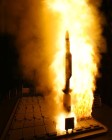
WASHINGTON (CNN) -- The U.S. Navy succeeded in its effort to shoot down an inoperable spy satellite before it could crash to Earth and potentially release a cloud of toxic gas, the Department of Defense said Wednesday.

art.satellite.usaf.jpg

A Delta II rocket lifts off, carrying a reconnaissance satellite that failed hours later.

The first opportunity for the Navy to shoot down the satellite came about 10:30 p.m. ET Wednesday. The plan included firing a missile from the USS Lake Erie in the Pacific Ocean west of Hawaii to destroy the satellite.

"A network of land-, air-, sea- and space-based sensors confirms that the U.S. military intercepted a non-functioning National Reconnaissance Office satellite which was in its final orbits before entering the Earth's atmosphere," a Department of Defense statement said.

"At approximately 10:26 p.m. EST today, a U.S. Navy AEGIS warship, the USS Lake Erie, fired a single modified tactical Standard Missile-3, hitting the satellite approximately 247 kilometers (133 nautical miles) over the Pacific Ocean as it traveled in space at more than 17,000 mph."

It was unknown whether the missile hit its precise target -- the satellite's full fuel tank. The Department of Defense said it wouldn't know for certain for 24 hours whether the fuel tank had been hit. However, several defense officials told The Associated Press the missile did apparently destroy the fuel tank. Video Watch a report on the successful shootdown »

"Debris will begin to re-enter the Earth's atmosphere immediately," the department said. "Nearly all of the debris will burn up on re-entry within 24-48 hours and the remaining debris should re-enter within 40 days."

However, even if the missile didn't score a direct hit, "any kind of hit provides a much better outcome than doing nothing at all," Adm. Mike Mullen, chairman of the Joint Chiefs of Staff, told reporters at Pearl Harbor, Hawaii.


The missile didn't carry a warhead, with authorities saying the impact was expected to be sufficient to destroy the fuel tank.

Navy gunners had just a 10-second window to fire, and officials had said they might not be able to take their shot on the first opportunity. Earlier Wednesday, officials had expressed concern about weather conditions, saying the launch could be delayed. However, the 10-second window would have occurred on each of the next nine or 10 days. Video Watch Pentagon spokesman Jeff Morrell describe the launch window »

Officials had said the missile would not be fired until the space shuttle Atlantis landed, which it did Wednesday morning, to ensure the shuttle would not be struck by any debris from the destroyed satellite.

The attempt cost up to $60 million, according to estimates.

Without intervention, officials say, the satellite would have fallen to Earth on its own in early March. However, since it malfunctioned immediately after it was launched in December 2006, it had a full tank -- about 1,000 pounds -- of frozen, toxic hydrazine propellant.

The fuel tank probably would have survived re-entry if the satellite had fallen to Earth on its own. That could have dispersed harmful or even potentially deadly fumes over an area the size of two football fields. Hydrazine is similar to chlorine or ammonia in that it affects the lungs and breathing tissue.

The Chinese military destroyed an aging weather satellite last year, prompting questions about whether the United States is merely flexing its muscle to show an economic and military rival that it can destroy satellites, too. James Jeffrey, deputy national security adviser, denied that this week, saying, "This is all about trying to reduce the danger to human beings."

But Beijing appears to have doubts.

"China is continuing to closely follow the possible harm caused by the U.S. action to outer space security and relevant countries," Foreign Ministry spokesman Liu Jianchao said Thursday.

"China further requests that the United States ... promptly provide to the international community the necessary information ... so that relevant countries can take precautions."

In 1989, a U.S. fighter jet destroyed a U.S. satellite by firing a modified air-to-air missile into space from an altitude of 80,000 feet. That adds to evidence that the U.S. acted Wednesday strictly to guard against the prospect of a potential disaster, said Gen. James Cartwright, vice chairman of the U.S. Joint Chiefs of Staff.

The military timed its shootdown attempt so that resulting debris would tumble into the atmosphere and not interfere with other satellites, said Christina Rocca, a U.S. diplomat and expert on disarmament. Her comments were included in an online United Nations report on this month's Conference on Disarmament in Geneva, Switzerland.

The military also timed its efforts to minimize the chances that debris would hit populated areas. But the United States is "prepared to offer assistance to governments to mitigate the consequences of any satellite debris impacts on their territory," according to a report of Rocca's remarks on the Web site of the Geneva office of the U.N.

One Pentagon official said that since early January, a team including 200 industry experts and scientists had worked furiously to modify the Aegis air-defense missile system so it could shoot down the satellite. Among the team's challenges was modifying the sensors designed to detect the heat from an incoming warhead, as the satellite will be much cooler.

advertisement

The missile was to release a "kinetic kill vehicle," enabling it to "see" the satellite and adjust its course toward it if necessary, officials said.

In January 2007, China used a land-based missile to destroy a 2,200-pound satellite that was orbiting 528 miles above the Earth. The impact left more than 100,000 pieces of debris orbiting the planet, NASA estimated -- 2,600 of them more than 4 inches across. The U.S. agency called the breakup of the Fengyun-C satellite the worst in history.

terça-feira, 19 de fevereiro de 2008

CAVOUR o maior navio de guerra da Itália


VEJA REPORTAGEM COMPLETA EM:

www.navalpowercb.blogspot.com

FINCANTIERI CLASSE CAVOUR. O maior navio de guerra da Itália


DESCRIÇÃO
O novo porta aviões da marinha italiana, conhecido como classe Cavour, é o maior navio de guerra construído para aquela marinha. O porta aviões Cavour irá complementar o outro navio desse tipo, classe Giuseppe Garibaldi, consideravelmente menor que o Cavour.
A característica mais marcante desse novo porta aviões é sua flexibilidade de uso. Nele, além da ala aérea composta por aeronaves de asas fixas e rotativas, pode ser transportada uma grande quantidade de veículos terrestres ou barcos de desembarque para apoio a tropas anfíbias. Para se ter uma idéia da capacidade de transporte desse navio, vamos dar alguns dados. O Hangar tem 2500 m2 e acomoda 24 carros de combate Aríete ou, ainda, 50 veículos de combate de infantaria (IFV) Dardo, ou até 100 jeeps Iveco LMV. São transportados, também 416 fuzileiros navais. Some-se a isso tudo a ala aérea composta por 8 a 12 aviões de combate AV-8B Harrier plus (futuramente serão substituídos pelo moderníssimo caça multifunção F-35B Lightning II do qual a Itália participa do desenvolvimento); 8 a 12 helicópteros Agusta/ Westland EH-101 Merlin que são usados para missões anti-superfície e anti-submarina.

veja maiores detalhes no site
www.navalpowercb.blogspot.com


Navy Ship Prepares to Shoot Down Spy Satellite

Navy Ship Prepares to Shoot Down Spy Satellite


Navy Ship Prepares to Shoot Down Spy Satellite
Source: Associated Press
(newser) – The US Navy will attempt to shoot down a rogue American spy satellite Thursday, just days before it re-enters the earth's atmosphere, reports CNN. Officials plan to bring down the satellite from an Aegis cruiser at sea while it is still 150 miles above the earth, leaving enough time for a second attempt if the first one fails. • The 5,000 pound spy satellite was launched in December 2006 but immediately malfunctioned. It carries enough toxic fuel to pose a hazard if it crashes to earth. "If we miss, nothing changes. If we shoot and get a direct hit, that's a clean kill and we're in good shape," said a NASA administrator.

Source: CNN

Star Wars

US Navy takes aim at rogue satellite
Australia's News Network | Feb 19, 08

Satellite shooting is next as Shuttle heads home
New York Times | Feb 19, 08

China expresses concern over plan to shoot down satellite
New York Times | Feb 19, 08

domingo, 17 de fevereiro de 2008

Admiral Gorshkov: The Real Test of Partnership

Admiral Gorshkov: The Real Test of Partnership


Aurobinda MAHAPATRA (India)

Source: Strategic Culture Foundation

Russian Prime Minister Viktor Zubkov made a two-day official visit to India from 12 February 2008. The main purpose of the visit was to inaugurate Russian Year in India, besides presiding over the second joint forum for trade and investment. The visit acquired significance due to the recent differences over the air craft career Admiral Gorshkov and nuclear cooperation in the overall ambit of bilateral economic and defence ties. It is the defence cooperation that was/is the crowning glory of bilateral relations; hence any dithering in its pace would likely dampen relations. However, despite long drawn debates and discussions about the defence ties the recent developments indicate that both the countries, taking into account the changing imperatives of the world order, would muster enough political acumen to give final shape to the Gorshkov deal. In this context, it may not be an exaggeration to consider the Gorshkov controversy as a real test of partnership between India and Russia.

Admiral Gorshkov is a Soviet era aircraft career built in Ukraine in 1980s and decommissioned after the collapse of the Soviet Union ostensibly due to its expensive maintenance cost. The negotiation between India and Russia regarding the career started in 1997 but concluded in January 2004 in New Delhi at the presence of defence ministers of both the countries at a cost of $1.5 billion. The career a was necessity for the Indian navy, as its only aging aircraft career INS Viraat was going to be decommissioned in 2008. The Gorshkov was supposed to be delivered in the same year in order to fill the critical gap in the Indian navy.

It would be worthwhile in this context to narrate Indo-Russian defence relations briefly. The relations dated back to the heydays of the cold war when the economic and defence capability of India, surrounded by hostile powers, was at a poor shape. The then Soviet assistance was timely. Its willingness to come closer as reflected in the friendship treaty of 1971 was noteworthy. Whether it was the establishment of heavy industries or the issue of securing national sovereignty and integrity, the Soviet assistance was phenomenal. In fact, India’s army would be unimaginable without the Soviet/Russian weapons. The post-cold war, except the initial hiccups, has almost retained the same spirit in bilateral relations including the defence ones. In can be mentioned defence is the only sector that has flourished well in post-cold war environment characterised by, among other things, competitive arms markets.

Despite the growth trajectory in arms relations the recent controversy about the Gorshkov deal has raised hackles, thus putting strains on the sustainability of bilateral defence ties. Russia announced in November 2007 that the aircraft career would require a further $1.2 billion (almost double the cost agreed on in 2004) for its delivery in 2012, instead of 2008. The sceptics in bilateral relations preferred to call it a day. However, it appears naive to proclaim doom to defence ties without examining the emerging issues. In fact, the deal was signed hastily without studying the details. As one Indian defence official admitted, ‘the original contract was sketchy.’ For instance, the recabling of the carrier at the time of signing of the agreement was estimated to be that of 700 km, but later it discovered to be about 2400 km. Similarly, the ship requires more sea trials than envisaged earlier. There are other technical issues such as converting the ship surface into flattop were earlier under evaluated.

Reportedly, India has already paid $700 million for refitting work at the Sevmash shipyard in northern Russia. It would be difficult to abrogate the deal at this stage. In the difficult terrain of international politics which is currently assuming murkier shape and witnessing the ghosts of the cold war stalking in different parts of the world, it would be but prudent to further strengthen bilateral relations instead of weakening it. Obviously, such a redesigning and restructuring of relations necessitate political acumen and courage which can foster mutually agreed compromise, addressing national interests of both the countries. The best course in the case of the aircraft carrier, hence, is to renegotiate the deal to the satisfaction of both the parties. As per a report, Russia has taken steps in persecuting the officials of the Sevmash for the gaffe. India too has agreed to pay about half of the hiked cost. It is expected that the visit of high level Indian defence team, led by the Defence Secretary, to Russia on 19 February 2008 would give final and conclusive shape to the deal.

In a sense, it is good that the Admiral Gorshkov controversy cropped up. It might serve a forewarning for things to be tackled in advance while negotiating deals in future. Indo-Russian defence cooperation is remarkable and no two countries share such close defence ties which extend to joint research, design and production of weapons. The emerging imperatives of the 21st century necessitate cementing of strategic cooperation, governed by mutually beneficial cooperation in diverse areas. In this context, controversy involving Admiral Gorshkov can be considered a real test of partnership, which both the countries with the record of friendship and cooperation must pass without entangling themselves in short-term calculations.

sexta-feira, 15 de fevereiro de 2008

Brésil : De bonnes intentions, mais toujours pas de commande de sous-marins

Brésil : De bonnes intentions, mais toujours pas de commande de sous-marins

http://www.meretmarine.com/objets/400/4515.jpg

Un sous-marin du type Scorpène
crédits : Navfco

13/02/2008

Alors que DCNS est en compétition avec les Allemands et les Russes pour la vente de sous-marins au Brésil, aucune avancée majeure ne semble avoir été obtenue lors de la rencontre, en Guyane, des présidents Sarkozy et Lula. Le chef de l'Etat s'est contenté, hier, de confirmer que la France était prête à opérer un transfert de technologie pour décrocher le marché : « J'ai dit au président Lula que nous étions prêts à ce qu'un de nos sous-marins Scorpène soit fabriqué au Brésil », a expliqué Nicolas Sarkozy. En clair, rien de nouveau, l'offre des industriels français, tout comme celles de leurs concurrents, portant depuis longtemps sur la réalisation de sous-marin par les chantiers locaux. La question de l'aide française au développement des parties non-nucléaires du futur sous-marin nucléaire d'attaque brésilien n'a, en revanche, pas été abordée (*).
Le chef de l'Etat a préféré mettre en avant la perspective d'un « partenariat global », déjà évoqué lors de la visite à Paris, en janvier, du ministre brésilien de la Défense. Un accord, « dans le cadre du renforcement du partenariat stratégique » entre les deux pays pourrait intervenir en fin d'année, à l'occasion d'un sommet Europe Brésil.
On notera qu'en dehors du Scorpène, le président de la République a également évoqué la possibilité de fournir aux armées brésiliennes des avions de combat Rafale, réalisés en transfert de technologie.
Sous-marin d'attaque à propulsion classique, le Scorpène, développé par DCNS en coopération avec l'Espagnol Navantia, a déjà été vendu à 10 exemplaires. Le Chili et la Malaisie ont acquis chacun deux unités de ce type, réalisées en Europe, à Cherbourg et Carthagène. L'Inde a également commandé six bâtiments, qui seront construits en transfert de technologie à Mumbai.


quinta-feira, 14 de fevereiro de 2008

LA DISSUASION NUCLEAIRE EN 2030 [PESQUISA]

LA DISSUASION NUCLEAIRE EN 2030


La dissuasion nucléaire en 2030. Bruno Tertrais - décembre 2006 - 58 p. Cette étude consiste en une analyse prospective sur l’avenir à long terme de l’arme ...
www.frstrategie.org/barreCompetences/proliferations/dissuasionNucleaire.php

BRUNO TERTRAIS

Maître de recherche, Fondation pour la recherche stratégique

Décembre 2006

Cette étude consiste en une analyse prospective sur l’avenir à long

terme de l’arme nucléaire, et notamment sur l’avenir de la dissuasion

nucléaire française après 2015. L’horizon temporel retenu est 2025-

2030. Il s’agit notamment d’essayer de réfléchir à ce que pourrait être

le « monde nucléaire » de la première partie du

XXIème siècle, au-delà

de l’horizon des décisions de modernisation déjà prévues ou

envisagées, et d’en tirer des conséquences pour la dissuasion

française.

L’étude et ses conclusions restent sous l’entière responsabilité de la

Fondation pour la recherche stratégique (FRS) et n’engagent ni le

Commissariat à l’énergie atomique (CEA), qui a apporté son soutien à

sa réalisation, ni aucune autre institution gouvernementale française.


essaiDissuasion2030.pdf
1653K Exibir como HTML Baixar

terça-feira, 12 de fevereiro de 2008

Gorshkov deal: Russian PM may be carrying compromise formula


Gorshkov deal: Russian PM may be carrying compromiseformula

Moscow, Feb 11: Russian Prime Minister Viktor Zubkov, who is reaching New Delhi tonight on a crucial official visit, is believed to be carrying a compromise formula to resolve the issue of upgradation of aircraft carrier 'Admiral Gorshkov' for the Indian Navy.

But even if the negotiations for modifying the USD 1.2 billion deal signed between the two countries in 2004 is finalised, Russian media reports said the delivery of the upgraded aircraft carrier could be delayed by one more year to 2013.

Russia seems to be willing to settle for the reported Indian offer to pay some additional amount ranging upto USD 500 million to complete the project, Kommersant daily reported.

Moscow had earlier asked a staggering additional sum of 1.5 billion dollars claiming that the warship's retrofitting cost had been underestimated in the earlier deal.

India and Russia has signed a USD 1.2 billion deal in 2004 under which Russia's 'Sevmash' sAccording to local media, last week Zubkov was briefed by Deputy Minister for Industries and Energy Denis Manturov on the issue of Gorshkov upgradation.

Quoting Deputy Minister Manturov the paper said as India would be transferring the funds only in 2009, the delivery of the upgraded aircraft carrier could be delayed by one more year to 2013.

Local industry officials said the amount India is ready to additionally pay is not enough to complete the upgradation of the vessel. They are insisting that the signatory of the contract 'Rosoboronexport' should further negotiate with India to recover all the necessary funds.

Experts here believe that the Russian side is trying to put the burden of its own mismanagement and other organisational lapses on the Indian side.

According to defence industry analyst Konstantin Makiyenko, the Russian government should provide easy credit to the shipyard so that work does not stop and the aircraft carrier could be delivered in 2012 in accordance with the revised schedule.

He hoped that Zubkov's talks in New Delhi will settle the issue that has affected the Indo-Russian military ties.

Shipyard was to upgrade the Soviet-built Kiev Class carrier at the cost of USD 700 million and the rest amount was for supply of Mig-29K fighters for the carrier.

"During Viktor Zubkov's India visit a decision in principle could be taken to modify the contract and the new price would be negotiated in Moscow during Indian Defence Secretary Vijay Singh's visit beginning on February 19", the daily reported.

Bureau Report

INS Vikramaditya EX-Admiral Gorshkov

INS Vikramaditya Hits Delay, Cost Increases

fonte : Defence Industry Daily


SHIP_CV_Admiral_Gorshkov.jpg
Before.
(click to view full)
DII

On January 20, 2004 India and Russia signed a deal to refurbish and convert the 40,000t Soviet/Russian Admiral Gorshkov into a full carrier by removing the guns, anti-shipping and anti-air missile launchers on the front deck, and replacing it with a full runway and ski jump, changing the boilers to diesel fuel, enlarging and strengthening the rear aircraft elevator, and many other modifications. The announced delivery date for INS Vikramaditya was August 2008 – an ambitious schedule, but one that would allow the carrier to enter service in 2009, around the time as their light carrier/LHA INS Viraat (formerly HMS Hermes, last of the Centaur class) was scheduled to retire.

The Viraat’s retirement is now set for 2010-2012. India Defence reports that delivery of the Vikramaditya must be pushed back until 2010, however, due to cabling issues. As the Russians seek to evade the terms of their deal and negotiations drag on, however, some estimates are placing the ship’s in-service date even later.

Right now, there are 2 major concerns in India. One is that slipping timelines could leave India without a serviceable carrier. The other is the extent of the increases, especially if more are added once India has paid for most of the budgeted work and is deep into the commitment trap. Current estimates place the overall cost of the refit as high as $1.35 billion, but figures are not final and time/money tradeoffs may well lie ahead. The initial reports sparked controversy in India, but even the Ministry has now admitted their veracity. The buy has now become the subject of high level diplomacy – and an amusing recent rationale from the Russians…

Waiting for Gorshkov…

SHIP_CV_Vikramaditya_Model.jpg
After.
(click to view full)

According to the 2004 press release, INS Vikramaditya was supposed to enter the Indian Navy in August 2008. That looks almost certain to fail, but India’s Ministry of Defence initially denied reports of delays. Then, in May 2007, Chief of Naval Staff Admiral Sureesh Mehta said the ships will be delivered:

”...by late 2008 or early 2009…. Our officials, who are stationed at the spot, have said that the work is going on as per schedule and we can have a month long delay once the work is completed as that part of Russia is frozen for a long time.”

Later comments on this issue included this May 1, 2007 quote:

“The work is only three to four months behind schedule and we can expect the aircraft carrier to be delivered by late 2008 or early 2009”

Subsequent updates, however, have proven the critics correct, with even the Ministry admitting as much. Cost estimates and reports vary from $800 million plus at least $113 million, to $980 million plus at least $350 million. DID’s experience with Indian defense procurement issues is that figures mean little, beyond defining broad orders of magnitude. Transparency will eventually come, but deals with Russia mean that it will come only from pressure within India, and then only after all other alternatives have been exhausted. Reports until then are really a set of varyingly educated guesses.

That there is a real issue of both time and cost, however, can no longer be denied. February 2008 news reports are giving figures of up to 3-4 years before refurbishment and testing are complete, and the refurbished ship can join the fleet. This would place its in-service data at 2011-2012, which risks a gap with no serving carriers in the fleet if further delays occur or the INS Viraat retires slightly early.

Meanwhile, China is working hard to refurbish the 58,000t ex-Russian carrier Varyag, and some analysts believe the ship could be operational in a testing capacity by 2010.

INS Vikramaditya: Aerial Complement

MiG-29K
MiG-29K 3-view
(click to view larger)

Note that these timelines and cost figures for delivery of the ship do not include aircraft, which are contracted separately. The original carrier’s complement was 12 Yak-38 Forger V/STOL fighters, 12 Ka-28 helicopters, and 2 Ka-31 airborne early warning helicopters. The removal of the Gorshkov’s forward missiles, ski ramp, and other modifications will improve the ship’s air complement somewhat. The nature of its original design, however, means that INS Vikramaditya will still fall short of comparably-sized western counterparts like the 43,000t FNS Charles de Gaulle nuclear-powered aircraft carrier, with its 40-plane complement that leans heavily to fighter jets. Ranges given for the refitted ship seem to average 12-16 fighters and 4-16 of the compact Ka-28/31 helicopters; diagrams of the refitted carrier seem to suggest total stowage space for a “footprint” of no more than 15-16 MiG-29Ks, with each Kamov helicopter sporting a comparative footprint of about 0.4 and about 5-6 open spots on deck.

A related $740 million contract for 16 MiG-29K aircraft plus training and maintenance was confirmed on December 22, 2004, with an option for another 30 MiG-29Ks by 2015. They will be operated in STOBAR (Short Take-Off via the ski ramp, But Assisted Recovery via arresting wires) mode, and the MiG-29K was reportedly selected over the larger and more-capable navalized SU-33 because India hopes to operate them from an indigenous smaller carrier as well.

The Vikramaditya’s complement will also include Kamov Ka-31 AEW and/or Ka-28 multi-role helicopters, along with a complement of torpedo tubes, air defense missile systems, et. al. If India does indeed buy E-2C+/E-2D Hawkeye naval AWACS aircraft, as is currently rumored, they would be added to this mix and take up footprint slots of their own.

Updates & Contracts:

AIR Ka-28 Indian Navy lg
Ka-28
(click to view larger)

Feb 7/08: Zeenews quotes an unnamed “Russian official” with interesting and somewhat unsettling arguments, in advance of a high-level delegation’s arrival led by Indian Defence Secretary Vijay Singh:

“Moscow feels that the agreement for supply of the 45,000 tonne warship was signed at a time when the Russian ship-building company was in bad shape and India “used” the situation to sign the contract at lower price. The ship-building company was facing closure and was ready to sign any kind of contract when the contract was signed.”

Defense Industry Daily needs to look up the exact definitions to be certain, but we believe this process is known as “shrewd negotiation,” followed by “a deal.” Indian Naval Chief Admiral Sureesh Mehta appears to be using the same lexicon, and has publicly said that there should be no revision to the Goshkov contract. Still, India cannot receive the carrier she wants if the shipyard goes bankrupt, and Russia is holding the carrier. This gives the Russians considerable leverage in negotiations, unless India can find an alternate provider. There may be a way out, however:

“But Russia is willing to “compensate” for the cost of Gorshkov if it gets more military orders, which Moscow insists is not linked to 126 fighter planes that India is planning to buy but other defence purchases.”

Nov 19/07: India’s MoD confirms delays in the Gorshkov’s delivery and slow progress, without really answering any questions. It acknowledges that the Russian side has submitted a revised Master Schedule, attributing the delays to “Growth of Work.” In response, an apex level Indian committee under the Defence Secretary, and a Steering Committee under a Vice Admiral, have been set up. A team has also been stationed at the shipyard.

No word on the timelines or costs suggested; indeed, these are likely to remain under negotiation. Indian MoD release.

Nov 6/07: A top-level Indian Navy delegation is heading for Moscow to discuss the delay and price escalation in the Admiral Gorshkov aircraft carrier deal. A detailed financial and technical plan outlining the specific justifications and amounts will be presented to the Indian side, who is there to listen rather than to negotiate.

The report pegs the original price quoted for refurbishing the carrier was just under $980 million, adding that the Russians are insisting on cost increases of at least $350 million. Indian officials reportedly fear that the final escalation may end up being much more once they are deep enough into the commitment trap of having paid for work. The report also adds that the Navy “had reconciled itself to the fact that the delivery of the ship would be delayed from the original deadline of August 2008 by a few years,” a surprising development given the limited service life of India’s remaining carrier. If the government is indeed prioritizing cost containment over delivery dates, reconciliation of the INS Viraat’s service life with Gorshkov’s entry may prove difficult. IDRW.

Oct 18/07: India’s MoD finally admits the obvious, as part of an announcement concerning an Indo-Russia fighter development deal. India MoD release:

“The Defence Minister described the Agreement on FGFA as a ‘major landmark’ and said that the Indo-Russian relationship is on a trajectory to reach new heights…. Mr. Antony expressed satisfaction at the outcome of discussions on other important projects e.g., supply and licensed production of T-90 tanks, SU-30 MKI aircraft and other strategic issues. He admitted that there has been a delay in the delivery of the repaired and refurbished aircraft carrier Admiral Gorshkov along with supply of deck-based fighter aircraft MiG-29-K and said it was decided that some more studies by technical groups would be done to go through the details. He appreciated the efforts made by the Russian side to resolve issues relating to life cycle support of equipment of Russian origin.”

June 16/07: India Defence: High Level Indian Delegation In Russia To Re-Negotiate Defense Deals Pricing:

“With differences over prices delaying the delivery of upgraded Sukhoi multi-role fighters and Gorshkov aircraft carrier, India today rushed a high-level defence team to Russia with fresh proposals to break the logjam…. The visit of the team assumes significance with Defence Minister AK Antony admitting that New Delhi was facing “problems” in acquisition of the carrier Gorshkov as well as in negotiating a new deal to buy 40 more upgraded Sukhoi-30 fighters for the Indian Air Force.”

May 17/07: India Defence: No Delays in INS Vikramaditya Acquisition from Russia: Defence Minister. “However, sources from the Indian Navy had earlier confirmed reports being circulated in the Indian and Russian media regarding a possible two year delay in the acquisition of the Aircraft Carrier.”

Additional Readings

  • Bharat Rakshak – INS Viraat (formerly HMS Hermes, last of the British Centaur Class).
  • Asia Times (Aug 21/07) – India’s blue water dreams may have to wait. The Gorshkov isn’t the only carrier project in trouble. This article mentions the Gorshkov’s difficulties, and also details both the current state of the INS Viraat and difficulties with India’s smaller 37,500t indigenous carrier, which is reportedly slipping its schedule badly and will only be ready by 2015 at the earliest, instead of 2012

segunda-feira, 11 de fevereiro de 2008

PARA DESOPILAR

sexta-feira, 1 de fevereiro de 2008

Untitled

http://www.defense-aerospace.com/


Italy Awards Order for Four FREMM Frigates
 
(Source: compiled by defense-aerospace.com; posted Feb. 1, 2008)


PARIS --- The Italian Ministry of Defense has signed a contract for the
second batch of the FREMM multi-mission frigate program it is
developing jointly with France. No value has been provided for this
contract, which covers four additional ships.


The contract was awarded to OCCAR, the European Organisation for Joint
Armament Cooperation, which is acting as the program’s joint executive,
Italian Defense Undersecretary Giovanni Lorenzo Forcieri told reporters
during a Jan. 31 media event in La Spezia. This contract brings the
total number of FREMM frigates ordered by Italy to six, the first two
ships having been ordered in 2006.


“This program has substantial economic and employment benefits not only
for the Riva Trigoso and Muggiano naval shipyards, but also for
subcontractors such as Oto Melara, Selex and Elsag, and will provide
work until 2016,” Forcieri is quoted as saying in Italian press
reports.  


“We feared that the government crisis might block the contract’s
signature…The FREMM program is fundamental for Riva Trigoso, where it
will guarantee work-load for about ten years,” according to Sergio
Ghio, trade union representative for Riva Trigoso which, like the
Muggiano yard, belongs to the Fincantieri group.


The announcement comes as Fincantieri is preparing to cut metal for the
first two frigates. An event marking this milestone was scheduled for
Feb. 8. Each ship will provide about two years of work to the
shipyards.


The four latest ships have been entirely funded in the 2007 budget, two
by a special fund managed by the Ministry for Economic Development and
two by the Ministry of Defence.


Deliveries of the first two ships to the Italian Navy are scheduled for 2011 and 2012.


The prime contractor for the FREMM program is a joint venture company
between France’s Armaris (itself a joint venture between Thales and
DCNS) and Italy’s Orizzonte Sistemi Navali S.p.A., jointly owned by
Fincantieri and Finmeccanica.

Blogged with Flock

Untitled


Submarine Building Programme for South Africa Brought to Successful Conclusion
 
(Source: ThyssenKrupp Marine Systems; issued Jan. 31, 2008)
 
 
On January 30, 2008 the South African Navy took over command of “SAS Queen Modjadji”, the third and last of three Class 209/1400mod submarines. The delivery of the three submarines was part of a large-scale programme to modernise the South African Navy.  
 
The boat was handed over after the successful completion of all necessary sea trials at Howaldtswerke-Deutsche Werft GmbH (HDW) in Kiel, a company of ThyssenKrupp Marine Systems.  
 
The “SAS Queen Modjadji” is expected to leave for South Africa on April 2, where she is due to arrive on May 22. The official commissioning ceremony will take place at a later date, still to be defined, after the submarine has arrived in her new home port of Simon’s Town in South Africa.  
 
There the submarine will be united with her two sister ships, “SAS Manthatisi” and “SAS Charlotte Maxeke”, which have already been successfully performing in the service of the South African Navy since September 2005 and November 2006 respectively.  
 
The delivery of the “SAS Queen Modjadji” marks the end of another successful submarine project for the shipbuilders of HDW and Nordseewerke GmbH (Emden), both companies within ThyssenKrupp Marine Systems.  
 
The three submarines for the South African Navy represent the most modern version of the diesel-electric propelled Class 209/1400mod, which has been successfully built for export for many years by a German consortium.  
 
TECHNICAL DATA:  
-- Length over all: approx. 62 m  
-- Diameter: approx. 6.2 m  
-- Displacement: approx. 1,450 t  
-- Crew: 35 persons.  
 

Blogged with Flock

sábado, 26 de janeiro de 2008

Strategical and Tactical ideas

To Connect the Gaps, Build the Bridge Underwater

As the Navy moves to develop a future fleet designed to reflect the strategical and tactical ideas that are prevailing in our time, we believe it is going to require new calculations in balancing the requirements of major war and soft power. As we noted last week, the Navy surface fleet of 2012 will be the greatest naval force in human history when measured by raw firepower. As we have also noted many times in the past however, the surface fleet has a number of emerging requirements which trend towards a greater capacity in security operations, in both blue and brown water, and a surface navy of fewer but more powerful large warships is ill suited to meet that challenge.

To meet future challenges, we believe the Navy should add a new dimension to its future fleet studies. We observe that on the advice of Julian Corbett, the US Navy should disconnect traditional function from traditional classification in its future fleet designs, and only by doing so will the balance between the strategic peacemaker and warfighter requirements be achieved in the future fleet while at the same time, potentially expanding tactical capabilities.

In all eras of naval warfare fighting ships have exhibited a tendency to differentiate into groups in accordance with the primary function each class was designed to serve. These groupings or classifications are what is meant by the constitution of a fleet. A threefold differentiation into battleships, cruisers, and flotilla has so long dominated naval thought that we have come to regard it as normal, and even essential. It may be so, but such a classification has been by no means constant. Other ideas of fleet constitution have not only existed, but have stood the test of war for long periods, and it is unscientific and unsafe to ignore such facts if we wish to arrive at sound doctrine.

The truth is, that the classes of ships which constitute a fleet are, or ought to be, the expression in material of the strategical and tactical ideas that prevail at any given time, and consequently they have varied not only with the ideas, but also with the material in vogue. It may also be said more broadly that they have varied with the theory of war, by which more or less consciously naval thought was dominated. It is true that few ages have formulated a theory of war, or even been clearly aware of its influence; but nevertheless such theories have always existed, and even in their most nebulous and intangible shapes seem to have exerted an ascertainable influence on the constitution of fleets.

-Some Principles of Maritime Strategy by Julian S. Corbett, page 107

We are observing emerging trends and discussions towards the future fleet structure as the Navy struggles to match future resources with the future requirements outlined in new Maritime Strategy. With existing force structure plans in place, the challenge to meet the future strategic challenges with new future force structure requirements while also incorporating best tactical approaches that are counter to traditional roles is a daunting challenge for the Navy. We know the process is already underway, we acknowledge the challenges both political and institutional, but we have also observed the trends particularly apparent with the recent shuffle in leadership.

We recently observed a comment by Thomas Barnett, whom we believe is heavily influencing the strategic ideas that in turn contribute to the strategic requirement set for the future fleet. His influence in several articles of the January 2008 issue of Proceedings is further evidence of his strategic ideas taking hold within the Navy. We see this trend as a good thing, however we also note that his recent comment highlights Corbett's warning that it can be "unscientific and unsafe to ignore" alternatives to function and classification on the basis of tradition alone.

Truth on subs is that they're only good at three things: go after shipping, go after each other, hold nukes.

The last one is still marginally useful in small numbers.

The challenge in the design of the future fleet is to connect the strategical and tactical ideas that are driving future fleet metrics, but also connect those ideas to manage not only the warfighters major war role, but also manage the Navy's emerging peacemaker role in addressing the non integrating gaps driving the approach outlined in the new Maritime Strategy. To meet the future challenge, the surface fleet that is currently around 75/25 high/low mix warship structure will need to shift to a high/low mix somewhere closer to 40/60, perhaps even 35/65 if it is to meet the metrics of the surface navy peacetime requirements. We have previously outlined those metrics to include manned presence, persistence on station, quantity of force, and distribution of force to the vast regions involved. As we have previously noted, unmanned systems can be force multipliers for the warfighter, but there is no substitute for the presence of a sailor as a peacemaker. If the Navy is going to bridge future requirements of both warfighter and peacemaker, we believe part of that bridge should be built underwater.

As Corbett notes, function based on classification needs not to be constant, and we believe it is past time for a new calculus that addresses the emerging tactical and strategic requirements of our time. Barnett is discussing 'traditional' roles for submarines, but like many aspects of the nations military force designed in the cold war, the Navy is learning that 'traditional' isn't always best. In this regard, new ideas are required to maintain tactical superiority while also addressing strategic priority. We believe the submarine is best suited to be such a bridge.

The emerging future submarine force is very different than the submarine force of the cold war. Today's active duty submarine force offers the Navy 574 VLS cells specific to a cruise missile deep strike capability. A future fleet projected to include all 4 SSGNs, and perhaps 48 SSNs with VLS will feature close to 1200 cells for cruise missiles. From a tactical perspective, a true stealth platform like a submarine can conduct launches of land attack cruise missiles much closer to the enemy coast, allowing it much greater range, and can do so against a minor power with limited sea denial tactical capability, or a major powers with an advanced anti-access / area denial capability that would keep surface ships far back from the engagement line.

Strategically speaking, migrating a portion of the strike firepower the Navy requires for supporting warfighter requirements from sea off the surface fleet reduces the size requirements of the surface vessels that make up the surface fleet. The reduction of size implies not only a reduction in cost per unit, but a greater number of units that can ultimately be leveraged for the Navy's peacemaker roles.

Submarines offer very little to peacemaker roles beyond intelligence gathering and special operations, both of which (as Dr. Barnett accurately points out in a later comment) can be conducted to equal effect by surface forces. If the Navy intends to build a peacemaker force in the future that aligns to the ideas and ideals expressed in the new Maritime Strategy, the Navy would be both strategically and tactically wise to migrate more of the warfighter responsibilities to the submarine force, with the intention to expand the peacemaker capabilities of the Navy of which can only be conducted by the surface navy.

The truth on submarines we see is that for the Navy to evolve and balance its Leviathan role and SysAdmin role in the spirit of Thomas Barnett, the Navy should apply the strategical and tactical ideas of our time by transitioning the warfighter function to the underwater service as a means to enable the peacemaker capabilities of the surface fleet. The surface fleet, when relieved to some degree of one of its many primarily traditional functions, should then be in a better position to offer the contributions required to meet the strategic peacemaker objectives desired in spirit by the Cooperative Maritime Strategy.

We see it as both ironic, and understandable, that Dr. Barnett would dismiss the submarine casually as an instrument of the Leviathan to conduct war. Indeed it is exactly that! However it is also the key enabler for the Navy to remove some of the warfighter burden from the surface fleet, a surface fleet that is in high demand in dealing with the world that emerges within the content of Dr. Barnett's writings and vision.

uk A Sign of the Time

A Sign of the Time

I

A FAULTY meat fridge is forcing a Royal Navy aircraft carrier to return to base today just two days after setting off for the Indian Ocean.

HMS Illustrious departed from Portsmouth Naval Base on Monday to head the multi-national Task Group Orion 08 which will be carrying out exercises and diplomatic visits during the next four months in the Indian Ocean and Mediterranean.

Navy spokesman Anton Hanney said a refrigeration unit used to store meat on the warship had been found to be in danger of breaking down.

He explained: "She has a minor problem with her refrigeration unit. It hasn't broken down but because she is off the south coast, the sensible thing is for her to come in and get that fixed before she goes off again.

"It wouldn't be prudent for her to go off with the chance of the unit breaking down while she was in warmer climates and then engineers would have to be flown out to her to fix it.

"It will not delay her programme in any significant way, she will be able to make up 24 hours without a problem."

It is of coarse a completely understandable course of action, prudent even, but perhaps the best phrase is 'penny wise.' In a way, that phrase defines the Royal Navy today, dominated by a bean counter political culture comfortable reducing the image of the nations most historical national institution, and yes the Royal Navy ranks well above the monarchy only the tabloids pay any attention to outside Britain these days.

The Royal Navy is better than this, the most powerful vessel of the Royal Navy shouldn't need to turn home 2 days after deployment because a refrigeration unit might break, but it is a sign of the time. It amazes me the institution that almost single handedly ended slavery on planet earth would have so much difficulty repairing a refrigerator on its largest warship while on a deployment, that she would need to go back to port